Der Vortrag wird am 29. Mai 2026 mit Urheberrecht (eine Warnung an die Mampflers dieser Welt, die mich in den letzten Jahren gerne bestohlen haben…) aufgeschaltet. laStaempfli freut sich auf einen wundervoll-inspirierenden Abend im Das Dorf – DER KULTURORT WIENS. Seit der geniale Franz Schubert nicht mehr Impressario des Café Korbs ist, verlagert sich die Politphilosophie halt an die Obere Viaduktstrasse 2, 1030 Wien. Falls Sie Schriften nachlesen wollen von Regula Staempfli, hier einige Links: https://global-labour.info/de/2010/02/17/atlas-wirft-die-sozialdemokratische-welt-ab-regula-stampfli-2009/ und natürlich jeden Monat den Essay im ENSUITE: https://ensuite.we-are.gmbh/realistischer-journalismus-eine-grosse-tradition/
Willkommen im polit-philosophischen Denken zu:
Institutionen,
Körper,
Codes,
Geschichte,
Narrative
Neue Architektur der Macht zu den Themen Krieg und Pornokratie – wie üblich denkt laStaempfli mit Haut und Haar: originell, innovativ und nachhaltig.
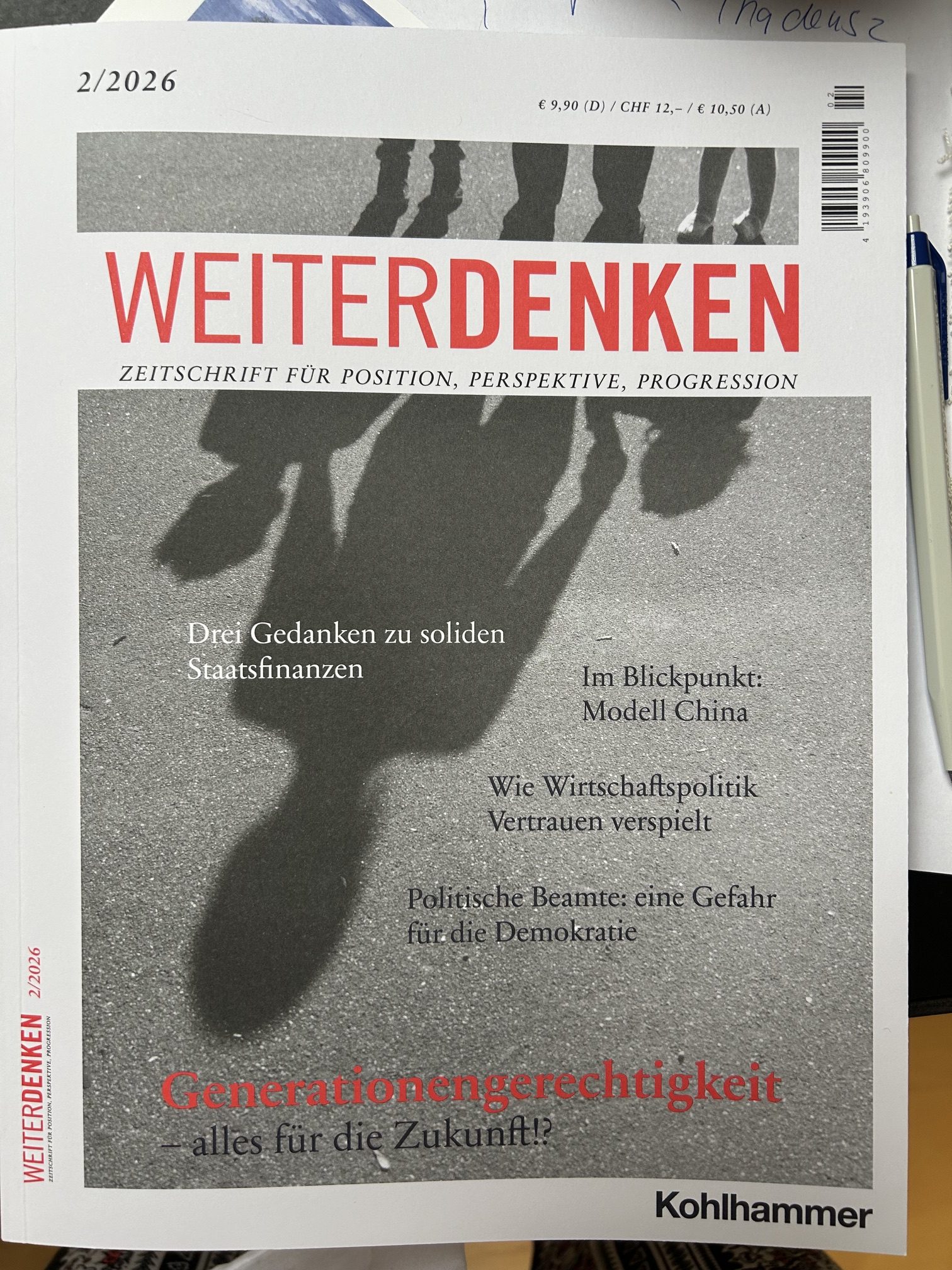
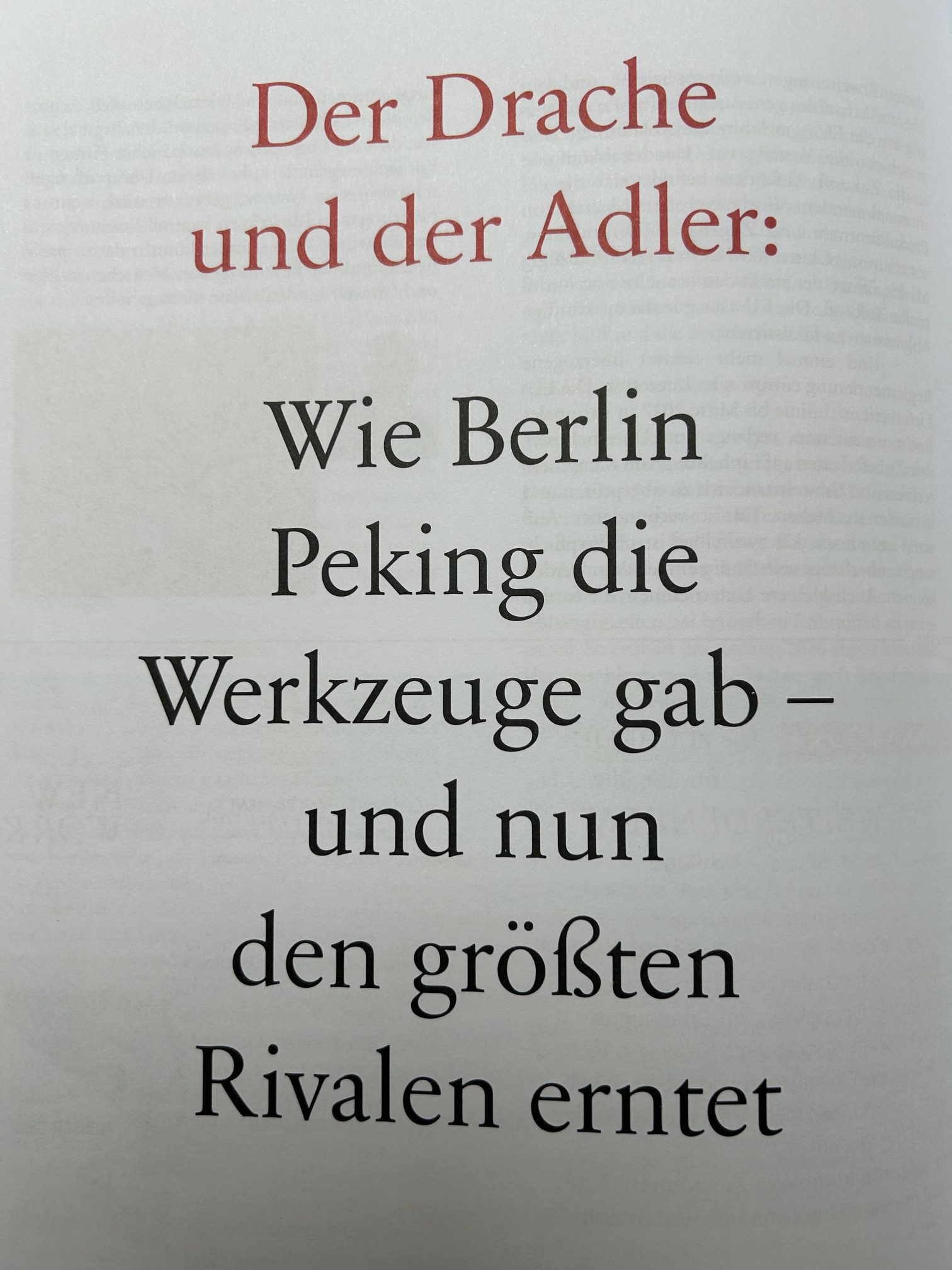
Der Kontrast zwischen der Wahrnehmung der VR China und der geopolitischen Realität ist in den deutschen Medien besonders krass. “Der öffentlich-rechtliche Rundfunk, einst als Vierte Gewalt gedacht, geriet zunehmend in den Sog digitaler Aufmerksamkeitsökonomien. Kultur- und Identitätsthemen dominierten die Dabattenräume. Klimabewegung, Genderdiskurse, Identitätsfragen, permanente Selbstvergewisserung über strukturellen Rassismus im Westen.” China war schlicht kein Thema – welch fataler Irrtum.
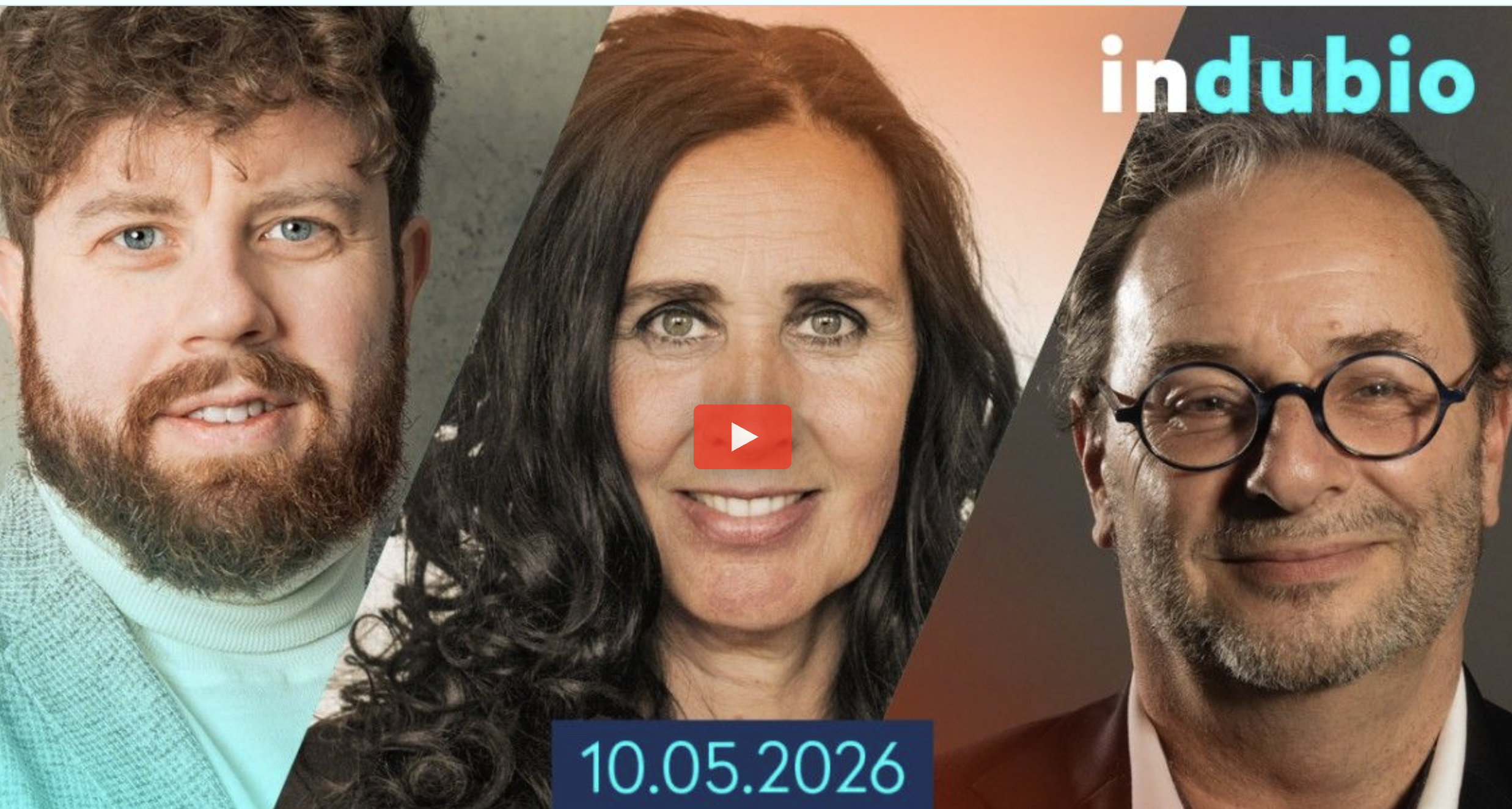
“Von Achgut.tv • Was bringt die neue europäische Plattform „W Social“, und wie unabhängig ist sie? Wie chaotisch ist der Platzhirsch X? Darüber spricht Gerd Buurmann mit der Politikwissenschaftlerin Regula Stämpfli vom Podcast „Die Podcastin“, mit dem Medienmacher Vadim Derksen von der Jungen Freiheit und mit dem Achse-Autor Thilo Schneider, Autor des Buches „The Dark Side of the Mittelschicht“.
Nachdem SPD, Grüne und Die Linke ihren Rückzug von der Plattform X angekündigt haben und diesen mit wachsender Desinformation sowie chaotischen Debattenstrukturen begründen, rückt eine neue europäische Alternative in den Fokus. Die Plattform „W Social“ wirbt mit einem verifizierten Nutzerzugang, europäischem Hosting und dem Anspruch, einen digitalen Debattenraum ohne Bots und Falschinformationen zu schaffen.
Hier die Thesen von laStaempfli als Vorbereitung für dieses Gespräch:
10 Gründe, warum der koordinierte X-Abschied von SPD, Grünen und Linken eine der dümmsten politischen Selbstverstümmelungen der letzten Jahre ist: Demonierung einer gemeinsamen demokratischen Öffentlichkeit (und ARD und ZDF applaudieren dabei noch.)
Sie überlassen das Schlachtfeld kampflos. X ist immer noch die größte, schnellste und unkontrollierbarste öffentliche Agora. Wer sie verlässt, gibt sie komplett den AfD, Rechten und allen anderen frei. Gratulation zum strategischen Eigentor.
Sie ziehen sich in ihre eigene Bubble zurück. Statt sich der harten Debatte zu stellen, flüchten sie zurück in die kuscheligen Echokammern von Instagram, Bluesky und Mastodon. Das ist kein Widerstand – das ist Verweigerung von Realität.
Sie zerstören ihre eigene Reichweite. Millionen von Menschen (auch Nicht-Wähler) erreichen sie nur noch über Filterblasen. Die eigene Position wird unsichtbar für alle, die nicht schon längst überzeugt sind.
Sie bestätigen das Narrativ der „feigen Eliten“. Wer vor einem freien Diskursraum wegrennt und „Chaos“ und „Desinformation“ schreit, während er gleichzeitig die Hoheit über die Narrative behalten will, wirkt einfach nur schwach und ängstlich.
Sie ignorieren, dass X unter Musk objektiv offener geworden ist. Mehr Meinungsvielfalt, weniger Zensur – genau das, was sie früher immer gefordert haben. Jetzt, wo es wirklich passiert, hauen sie ab. Heuchlerischer geht’s nicht.
Sie verschenken die direkte Kommunikation mit Bürgern. Früher hieß es immer „Wir müssen mit den Menschen reden“. Jetzt sagen sie: „Mit denen reden wir lieber nicht mehr.“ Toll.
Sie machen die AfD stärker. Jeder vernünftige Beobachter sieht: Die Linken räumen das Feld. Die AfD feiert das als Sieg – und zu Recht.
Sie widersprechen ihrem eigenen Demokratie-Geschwafel. „Demokratie lebt vom Streit“ – außer wenn der Streit auf einer Plattform stattfindet, die sie nicht kontrollieren. Dann plötzlich nicht mehr.
Sie isolieren sich selbst von der Wirklichkeit. Die Plattform ist voller normaler Menschen mit echten Sorgen. Wer sie verlässt, verliert den Kontakt zur gesellschaftlichen Mitte.
Es ist schlicht feige. Statt sich der Debatte zu stellen, laufen sie weg und nennen das „Haltung“. Das ist keine Haltung – das ist Rückzug ins sichere Eck.
Was das für den Diskurs bedeutet Der öffentliche Diskurs wird noch stärker gespalten. Die eine Seite (rechts/konservativ) dominiert den freien, unzensierten Raum. Die andere Seite (links/grün/rot) zieht sich in ihre kontrollierten, freundlichen Parallelwelten zurück. Das Ergebnis: Zwei getrennte Realitäten, die sich kaum noch berühren. Genau das, was sie angeblich verhindern wollten. Am Ende gewinnen nicht die Argumente, sondern die, die bleiben und aushalten. Die Linken haben gerade freiwillig das Spielfeld geräumt
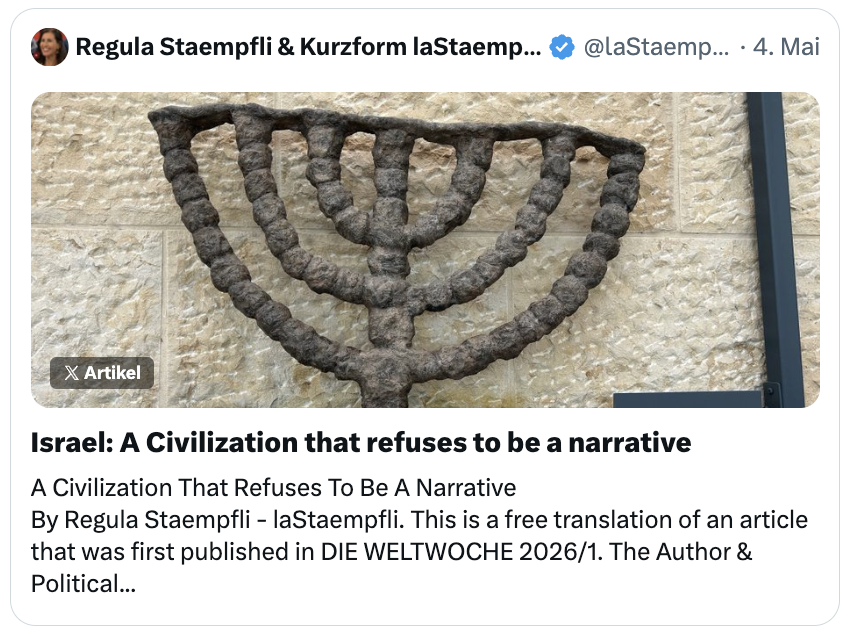
By Regula Staempfli – laStaempfli. This is a free translation of an article that was first published in DIE WELTWOCHE 2026/1. The Author & Political Philosopher (Professor at the Swiss Journalist School for over 20 years) went on her first paid media trip to Israel, after she had visited the country numerous times. Read here what she experienced.
The first thing you notice in Israel is not conflict. It is intensity.
At Ben-Gurion Airport, a young woman in military uniform laughs, holding her phone, balancing an automatic rifle against her shoulder as casually as a Parisian might carry a handbag. Nearby, a father lifts his daughter high into the air as if he had just recovered her from history itself. Three languages collide in one sentence. Someone argues. Someone embraces someone else with the urgency of people who understand that existence is never guaranteed.
Nobody pretends not to see one another. To a European, that alone feels revolutionary.
In Western Europe, we have perfected the art of polite invisibility. We move through public spaces like well-trained ghosts. We do not stare. We do not interfere. We do not ask questions. Israel runs on the opposite principle: attention is survival.
You feel it immediately at passport control. The questions are direct, personal, intelligent. Not bureaucratic rituals but human inquiries. Where have you been? Why are you here? Who do you know?
The officer is not checking documents. He/She is checking reality.
Ten minutes later, I step into Mediterranean sunlight and realize something unexpected: you do not simply arrive in Israel geographically. You arrive existentially. I did not travel to Israel to form an opinion. The world produces an excess of opinion about Israel—fine desert dust, impossible to remove, constantly reapplied by media, universities, activists, and people who have never been there.
I traveled to understand something else.
What does it mean to live where history is not the past? What does it mean to build a future when the past refuses to disappear? How does a society function when survival is not theoretical?
The first thing I understood was this: Israel offers no moral comfort. Anyone arriving here in search of ethical reassurance leaves intellectually disoriented. For many Germans, Israel still functions as a moral landscape shaped by historical guilt. Watching that framework collapse can be revealing. During one guided visit, a participant asked when Israel had been created “because of Germany.”
The guide paused, then answered simply.
Israel did not begin in 1948. Israel did not begin in 1933. Israel did not begin in Auschwitz.
Israel began thousands of years ago.
You could almost hear the architecture of belief giving way. The guide continued. Ancient Judea. Roman destruction. Renaming into Palestina. Continuous Jewish presence. European Zionism. Herzl. Basel. Agriculture. Migration. Technology. War. Survival. No moral fairy tale. No narrative closure. Just history.
Israel did not emerge from guilt. It emerged from continuity.
From survival against probability, from argument as method, from technological stubbornness, from religious imagination, from the improbable meeting of European political theory and Middle Eastern geography—from something the contemporary West increasingly struggles to understand: civilization-building. Since October 7, 2023, I have returned to Israel several times. This time it was an official press visit. The reactions at home were predictable.
“Are you Jewish?” “Why would anyone go there?” “Isn’t it dangerous?”
Eventually I began answering symmetrically. When someone mentioned traveling to Vietnam, I asked whether they were Vietnamese, had family there, or perhaps sympathized with communism.
The outrage was immediate. “That’s completely different!”
Is it?
Or is Israel simply the one country people believe requires moral permission to visit? Traveling to Israel teaches something simple: people do not react to Israel. They react to their own narratives about it. Even a trip to the Moon would provoke less projection.
But luckily I realised on my trip: Israel, finally, has stopped caring. Because no matter what the country does, defend itself, accept terror just for peace – the ancient antisemitisms are being served at all times. The country no longer seems particularly interested in managing its image abroad. Only the diaspora continues to obsess over moral positioning—often unaware that similar distancing mechanisms once helped exclude Jews from professional life in Berlin in 1933 and Vienna in 1938. So finally: Israel has stopped caring but has really understood surviving – as it had to for thousands of years.
The only institutions that care about Israel obsessively are Western Universities, anticapitalist NGOs, antisemitic NGOs, Western Media, intellectual circles who are on the crusade against everything our Western democracies stand for. Ach, all these institutions which had provided me with a home – until the latest October 7th 2023.
The Israeli response can be summarized in two words:
Let them.
Israel is not interested in branding. Israel is interested in survival. And survival produces a very different psychology from reputation management. Israel’s younger generation does not seek European approval. They are too sophisticated, too hardened, too ironic, too experienced with reality. They do not believe in narrative identity. They believe in competence. This may be what unsettles Western observers most. Israel does not perform existence. Israel practices it. No staged fear. No curated chaos. Israel is a society in motion. Religion here is not aesthetic decoration. It is lived structure. Even atheists are immediately recognizable. And that clarity is oddly refreshing: you know what people believe, and often who is trying to improve life not only in heaven, but on earth. “Skyscrapers?” my friend Ariel laughs. “My dear, these are built ideas.” That may be Israel’s true paradox: one of the oldest and most future-oriented societies on earth. Few people understand how deeply Israel is embedded in global systems—water desalination, agriculture, medicine, cybersecurity, digital infrastructure. If boycotts against Israel were ever fully implemented, the consequences would not be symbolic. They would be immediate. Israel demonstrates a simple political truth the West increasingly forgets: Nations become what they invest in.
Invest in people, education, technology, and freedom—and democracy becomes possible. Invest in ideology, repression, and corruption (like Iran, Gaza) —and you destroy first your own population, then the stability of others.
On my last evening in Tel Aviv, I sat in a small café near the sea. Plastic chairs. Strong coffee. Young people speaking Hebrew so fast it sounded like jazz. At the next table, three soldiers discussed software. Not war. Software. One explained a start-up idea. Another complained about his mother. The third texted someone he was clearly in love with.
War and life existed in the same conversation without hierarchy. Israel does not live in fiction – it lives in reality. It struck me then that this might be the deepest cultural divide between Europe, the USA and Israel. In the West, we debate representations. In Israel, people deal with consequences. In Western universities, identity has become performance. In Israel, identity remains existence. We analyze. Israel builds. We interpret. Israel repairs. We debate. Israel prepares.
On my flight back to Europe, I realized something uncomfortable. Perhaps the real question Israel poses to the West is not political. It is civilizational. What happens when representation becomes more important than survival? When performance replaces responsibility? When saying something replaces doing something? Israel offers no easy answers. But it offers something more valuable: A reminder. A reminder that civilization is not sustained by discourse alone. It is sustained by people willing to build, defend, repair, argue, innovate—and sometimes fight for its survival. And as the plane crossed back into European airspace, I found myself thinking:
“In an age obsessed with narrative, Israel may be one of the last places still insisting on reality.”